About Ms Bettencourt

Ms Bettencourt is a Swedish built 25-foot trailerable trawler. Her hull was completed in 1971, No. 1117 of about 2500 built. The boat is named for my wife Dia, whose maiden name is Bettencourt.

This little vessel came to me as a gift in 2004. Before then she had been abandoned about 12 years on the Savannah River near Augusta, GA. I have repaired and refitted the boat extensively, and I have cruised her along the East coast of the US, from Cape Lookout, NC, to the Florida Keys. I dream of taking her to Havana some day.

This blog started in 2011 to chronicle the building of a hard top for the boat to replace leaky canvas. Since then the blog has become an Albin-25 boatkeeping and cruising journal.


Saturday, December 15, 2012

A hard day for the kingfisher

I have been watching this bird, which turns out to be a Belted Kingfisher, much of the morning. I can't get close enough to get a photo, but a picture I found on the Cornell Ornithology Lab website portrays her perfectly.

Cornell  Ornithology Photo
It is unusually raw, cold and windy here today. But the bird continues to work. Sometimes perched, feathers puffed up, on the weather vane; sometimes on a piling; often skimming inches off the river's surface, always looking for something -- presumably something to eat.

She is noisy too. She has a rattling, chortling, officious kind of call, issued both at rest and in flight. I can see only one of these birds around our dock, so maybe this one is seeking a mate or broadcasting a warning.

Anyway, witnessing this bird's work ethic in action made me feel more than a little guilty. Though the temperature is only in the 40s, cold, wet, windy weather slows me to lethargy.

But bird-driven shame finally propelled me to boat work.  I winterized Ms. Bettencourt's pressure water system.


This did not require a lot of effort. Just disconnect and shunt the water heater's in and out water lines and drain the water heater tank.


Then use the pressure water system pump to drain the bow tank. With the tank empty, disconnect the water system feed hose and stick it into a jug of RV antifreeze.

Turn on the pump to distribute the antifreeze through water lines, faucets and the fresh water head plumbing. Turn off the pump and close the drain cock under the sink.

Ms. Bettencourt is now ready for the whatever winter weather happens around here. If the temps get into the mid-20s, I'll hang  a light bulb in the engine box. But that is not needed now.


The bird, meanwhile, is still skimming around, nabbing an occasional minnow and making a hell of a racket. According to the bird book, when her day is done she will go home to a burrow in the riverbank.

Though it has been suggested that I make a start on Ms. Bettencourt's new curtains, I'm headed back to the rocking chair by the hearth and the gas logs. I was sitting there earlier, reading a novel, when I  happened to look out the window and see that bird.

She's still working. I'm not.


Saturday, December 8, 2012

Finessing the port-side docking

I  have been spectacularly unsuccessful in multiple attempts to back Ms. Bettencourt into the inside slip at our dock on the Savannah River. I have been searching  for a key to achieving this maneuver, but I have consistently failed to coax the boat to go backwards upstream in the direction I desired.

Yesterday, an idea occurred: "Why not come in bow-first and spin her around to a port-side docking under power?"

Right after that, there came a second thought: "It's not like I have never hit a piling before...."

Think about rotating a 25-foot boat 180 degrees under power in a 35-foot rectangle of eddying river with pilings and rocks nearby. I tried anyway. And it worked. I have been practicing and I have gotten reasonably good at it.


Entering the pocket (right) and lining up for a scary-close approach to the riverbank.


A sandy shelf extends out about six feet from the rocks, then the depth drops off  to 10 feet. Ms. Bettencourt draws two feet. We did not touch ground on this approach.


Beginning the turn, wary of the piling on the port quarter, with the current trying to move the boat sideways to starboard.


Backing and filling to get lined up.


The bow finally turns. Port quarter smacks a piling, lightly.


This is where I boat-hooked  a spring line previously laid out on the dock, leading the line to a cleat on the port quarter. Going astern on the spring line brought the port side to the dock...


Dia Bettencourt photos


...where I was able to step out, complete the mooring and declare victory. (Click to enlarge the photos and see the look of relief on my face).


It was fun figuring out how to do this maneuver. But constantly changing river current and wind, plus the tricky eddy in the pocket between the dock and the rocks make this kind of docking too troublesome and risky for every day use.

And, this is not a 5-second ski boat turn. My approach-to-docking time was about 10 minutes -- hardly a "smartly-done" docking evolution.


Saturday, December 1, 2012

Reeking of diesel; nearly ready to cruise

The job of replacing the fuel gauge sending unit inside Ms. Bettencourt's diesel tank is about 99% finished. The remaining 1% consists of finding and installing a screw I dropped in the bilge.

I abandoned an earlier plan to wait until the tank was dry before beginning the work. Installing the new sender with a nearly full tank wasn't too messy, though it will probably take a few days before I get the diesel smell off my skin. Actually, it may be a week or more before the smell goes away, since I still have to replace the cartridge in the primary fuel filter.

Soon, the boat will be fully serviced and ready for her next cruise.

Meanwhile, I took a day off from Ms. Bettencourt work today and went on Safari.

Safari is the name of Albin-25 #2050, which is owned by my new friend Steve in Greenwood, SC. While Steve's Albin is more than 1,000 production hulls newer than Ms. Bettencourt, it has had a hard life until now. The previous owner had converted it to a ketch rigged motor-sailor before he fell ill and died. The boat was stored and not used for a number of years before Steve acquired it.

Safari is definitely a fixer-upper now, but she came to Steve with a brand-new Yanmar diesel engine and drive train, and most other major systems are in order. He has begun the restoration and I have offered to help.

I was impressed with Steve's boatyard work space. He has erected a 10 x 27 foot canopy over Safari in his back yard.

I think this is a neat idea. This is just the kind of temporary cover I will need when I repaint the topsides and repair a few fiberglass cloth bubbles that have arisen on Ms. Bettencourt's new top.

We have a perfect place for such a temporary structure on a piece of land we own adjacent to our home. Soon, I will be on the hunt for a similar canopy rig.

(One possible complication with this plan is the fact that Ms. Bettencourt sits about 18 inches higher on her trailer than does Safari. I will have to find a work-around for this problem).

But, all that will have to wait until after Ms. Bettencourt's next cruise, which is now moving toward definite dates sometime next month.

My friend Major and I plan to trailer Ms. Bettencourt to Savannah and put her in the water there. Then we'll cruise northward for a few days visiting Beaufort and Charleston, SC. Our plan is to tuck in most nights in comfortable marinas with dockside electricity and restaurants nearby.

Unfortunately, I continue to dither with the new curtains project, so we will be using the curtain rods as towel  racks and our towels for privacy curtains yet again.


Saturday, November 24, 2012

Failing to make friends

It is said that currents and winds should be our friends when maneuvering a boat in close quarters. We live on a flowing river and our dock is in a place with persistent northerly winds. I have learned to cultivate friendships with winds and currents. Particularly when docking. I have become famously successful at this, both with twin and single screw inboard engine boats -- as long as the bows point upstream and upwind.

Docking in close quarters with the stern upstream is another story entirely.


How did this happen?


Since we moved the houseboat to the outside of the dock, Ms. Bettencourt has sheltered on the shoreside. Here, she is shown moored with her stern upstream. But, surprisingly, I have not been able to make friends with wind and current in this slip. There is a current eddy in this little pocket of water and the wind is always flukey and often gusty.


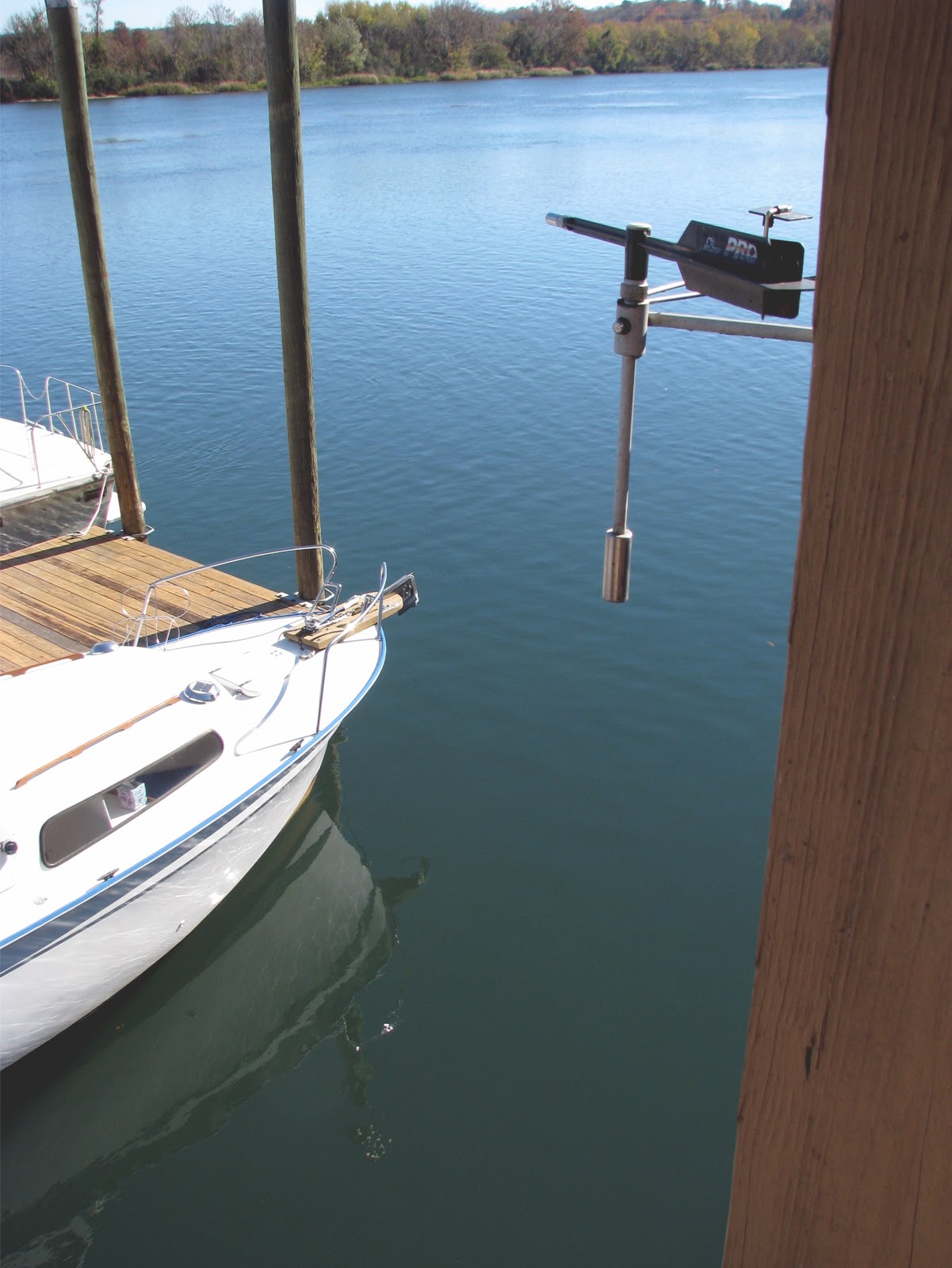
It is not uncommon for the weather vane atop the gazebo to be registering a steady northwesterly breeze, as it did this morning....


...while the telltale I have mounted over the water about 15 feet  below the weather vane is indicating northeast to easterly winds. (These photos were taken less than a minute apart).


It is not difficult for me to overcome these variables when entering this slip bow-first. If the surface wind is westerly or if it is stormy, I will use a springline,  idling in forward gear to hold Ms. Bettencourt's starboard side to the dock while I tie up.

But, to date, I have been unsuccessful at backing her into this position. Asymmetric thrust from Ms. Bettencourt's right-hand propeller, a relatively small rudder, cramped maneuvering space, slow speed and intimidating obstacles such as these pilings and rocks...


... comprise a test of nautical courage that I continue to fail badly.

So, to answer the question at the start of this post:

How did this happen?

I have been coming in bow-first, then jumping to the dock and using a long line from the port quarter and a big fender to flip her bow downstream.

This is an effective process, the nautical term for which is "winding ship."

But for me, it is not very satisfying. Doing it this way seems like cheating.  This maneuver can't be done with docking 'elan. Passersby would be unimpressed.

So, I will continue to practice stern-first approaches. I think success will depend on learning how to steer in forward gear, whist making sternway in the desired direction. And, of course, I will have to become very friendly with winds and currents in this constricted area.

Perhaps an effective method will develop sometime soon, in which case I will post a video. Please stay tuned.


Saturday, November 17, 2012

Dealing with @!*#! canvas fasteners

A device known as the "lift the dot" canvas fastener ranks at the very top of my marine hardware enemies list.

It's a post and spring assembly  that is supposed to secure a canvas closure and to release when you lift at a dot stamped on the fastener face. It does the first function admirably. But I can't get mine to let go -- short of prying them apart with a tool.


Ms. Bettencourt's new canvas has a bunch of these things, installed mainly to hold rolled up canvas or clear window panels with vinyl straps.

I am replacing them with Common Sense twist-lock stud  fasteners from Sailrite:
http://tinyurl.com/b79tttr


Here's the hardware, together with an eyelet I found easy to install on one of the side panel roll-up straps: (My pocket knife is in the picture to provide a sense of scale). The pieces are, from the top:


-A twist-lock stud and its backer plate


-An eyelet installed on a vinyl strap

-An eyelet and its backer washer


I think you can see why they named these  Common Sense fasteners. Installing the first eyelet was a simple job, though I probably would have messed up had I not watched the how-to video that Sailrite provides on its website.

Putting the stud part of the fastener on the canvas was even easier, since the the prongs on the stud fit neatly in the slots the canvas guy had cut in the material for the "lift the dot" fastener posts.


And here's a completed assembly on the canvas, the first of many I need to get done while the weather remains sunny and dry.


In other news-- I found the the reason the fuel gauge dropped to beyond empty and refused to move, even though the tank is full to the fill neck. The solution was simple: I Googled "troubleshooting Teleflex gauges" and found a step-by-step process on the Jamestown Distributors website: http://tinyurl.com/coory5g

It turned out that there is nothing wrong with the gauge. The sending unit inside the tank has failed. I have acquired a replacement sending unit, but installation will have to wait until I have used up most of the fuel in  tank. At Ms. Bettencourt's usual consumption rate, that will be about 29 hours of engine running time. The tank might be nearly dry sometime next spring.

And finally, the curtains project remains on hold. This job might have to wait until spring as well. I still can't muster sufficient confidence to start cutting that expensive material.


Saturday, November 10, 2012

500 Boats!

Fifty-three rowing clubs from 38 cities and 13 states are on the Savannah River today for the 16th Annual Head of the South Rowing Regatta. This is a day-long, 76-event big deal in Augusta.


In the photo to the right, a flock (fleet?) of 6s and 8s are heading out from the Augusta Rowing Club Boathouse. The starting line is about 5,000-meters upstream.


Early morning temperatures on the water were in the 40s, but if any rowers found this uncomfortable, they didn't seem to show it.


Some are stripped for action, but the coxswain of this 8 remained bundled up and kept her ears warm.


We were on the race course in Ms. Bettencourt yesterday and the water temperature at the surface was 61F.  The river is now closed to all but regatta traffic from a mile south of the Boathouse to about a mile upstream past the downtown area. There are more than 1,300 competitors on the water, plus event judges, timekeepers, safety people and others.

Today looks like a good day to stay home and figure out why Ms. Bettencourt's fuel gauge has stopped working.


Saturday, November 3, 2012

Moving the Big Guy

There is something very pleasurable about having your hands on the throttles of  big engines; having the ability to summon about 500 horsepower with just a push of the palms. That memory flashed back this week when I fired up the big V-8s on the houseboat "Tybee Island" and shifted her berth to the outside of our dock on the Savannah River.


Houseboat Tybee Island at her new berth


          The levers of power


Actually, I hardly used the throttles. Over the years we have owned this boat, I have become adept at maneuvering in close spaces with the transmissions alone. With the engines idling, I put the rudders amidships, then leave the steering wheel untouched.

In this case, shifting the port engine astern and adding a little port throttle backed us out of the slip just as slick as a snake. Then some back-and-forth shifting, again with engines idling, engaging one transmission, then the other, forward, then astern, then both ahead, brought us alongside the dock face, where Dia was waiting with a bow line. In all, a very satisfying evolution.


Maneuvering with transmissions


This was the first time I had moved the 47-footer since last April. There was a problem with one of the Rochester QuadraJet carburetors, compounded by an extreme case of houseboat disinterest. This resulted in ever-lengthening periods of the boat just sitting there, making us feel bad about not using her.

We have decided to put Tybee Island on the market, and my job is to get the boat ready for an appraisal, a precursor to advertising it for sale.

We are the second owners of this Harbor Master houseboat. She's 25 years old, but still shipshape and frisky. The boat has just about every feature imaginable- fly-bridge with Bimini top, two heads, two staterooms with double beds, three air conditioners, big kitchen, full-sized fridge and so on. She also has those two big Crusader inboard engines, a 4-cylinder 6.5 kilowatt generator and a 200 gallon gas tank, which is about half full at the moment.

Making her ready for sale is a bittersweet task. We have owned the boat about 10 years and have had many happy times with her. But our interests have changed. Disuse is not good for a boat.

Meanwhile,  Ms. Bettencourt has been moved to the comfy inside slip, where she is even more accessible for curtains fittings and for future cruise preparations.