About Ms Bettencourt

Ms Bettencourt is a Swedish built 25-foot trailerable trawler. Her hull was completed in 1971, No. 1117 of about 2500 built. The boat is named for my wife Dia, whose maiden name is Bettencourt.

This little vessel came to me as a gift in 2004. Before then she had been abandoned about 12 years on the Savannah River near Augusta, GA. I have repaired and refitted the boat extensively, and I have cruised her along the East coast of the US, from Cape Lookout, NC, to the Florida Keys. I dream of taking her to Havana some day.

This blog started in 2011 to chronicle the building of a hard top for the boat to replace leaky canvas. Since then the blog has become an Albin-25 boatkeeping and cruising journal.


Saturday, May 17, 2014

Marooned (probably forever)

Army Corps of Engineers divers were at the New Savannah Bluff Lock and Dam this week. They spent most of a day underwater around the lock wall on the Savannah River side of the lock.

U.S. Army Corps of  Engineers photo


There has been no official word on findings, but a person I know who is close to the action said the engineers she talked with sounded "really worried."

The lock was closed indefinitely Thursday. There are currently no plans to repair and re-open the lock. Augusta's river access to the sea is closed.


I went to the Augusta Ports Authority meeting Thursday and no one seemed to be particularly concerned.

Sighhhh....

Saturday, May 10, 2014

Not since Sherman seized Savannah


Here’s an epochal development in the history of Augusta that seems to have completely escaped the attention of our political leaders and local media:

For the first time since the capture of Savannah by Union forces in 1864, Augusta’s river access to the sea is to be cut off. And this time, it sounds like it will be permanent.

On May 8, the Army Corps of Engineers posted a notice on its “Balancing the Basin” internet blog, http://balancingthebasin.armylive.dodlive.mil/2014/05/08/nsbld/ The post begins with the following paragraph:

“The U.S. Army Corps of Engineers Savannah District and the City of Augusta, Georgia, will close all access to a portion of the New Savannah Bluff Lock and Dam on May 15 due to safety concerns with the aging structure. Operation of the lock will also end May 15.”


The Corps of Engineers drawing at right details problems with the downstream end of the lock wall. You might want to click this image to enlarge it.


In addition to closing water access to the Port of Savannah, this act turns Augusta’s part of the Savannah River into a skinny 13-mile-long lake.  This lake is impounded only by the aging, and now officially unsafe, dam that no one seems to have any plans to repair.

Three major consequences come immediately to mind:

  •  Water supplies for the cities of Augusta and North Augusta, plus all the industries along the reach from Augusta to the dam are threatened by unabated deterioration of the dam.

  •  Prospects for a revival of river commerce to and from Savannah’s growing port are extinguished.

  • River tourism, including development of Augusta as a large pleasure boat destination for vessels using the River between Augusta and the Atlantic Intracoastal Waterway at Savannah is no longer feasible.


Then there’s the matter of all the large boats moored between the dam and the end of upstream navigable waters. 

By my count there are more than 50 such vessels with lengths between 34 and 60 feet parked along the river between Gum Swamp, SC, and the Augusta Marina. These boats live in the water. They are too big to trailer.

In the past, many have gone to marine facilities in Savannah for major out of the water repairs and maintenance.  In the future, out of water maintenance and trips to the coast will have to begin with expensive boat moving contractors using cranes and other specialized equipment.

These vessels are effectively marooned.

All of these developments should not come as a surprise to our political leaders. The U.S. Congress, in the Water Resources Development Act of 2000, authorized the Corps of Engineers to rehabilitate the lock and dam and turn it over to local governments for operation. At that time the cost was estimated to be about $24 million. The money was never appropriated.

Since then, it seems to me, our political leaders, both locally and in Washington, have done nothing to get the money and start the work to fix the lock and dam. I am hopeful that this week’s lock closure will be a wake-up call for citizens and decision-makers to get a process started to save our access to the sea.

Yesterday, a friend who will be 98 years old next October, told me when he was a boy, well before the lock and dam was built, it was not uncommon to be able to walk across the Savannah River at 5th Street during summer droughts. “It was just a trickle,” he said, “you could jump across it.”

I have no doubt that, without some organized and passionate intervention to repair the structure, the lock and dam will continue to deteriorate to eventual catastrophic failure.
“Just a trickle” of Savannah River at 5th Street could be in our future.

Ms. Bettencourt, however, is free to ride her trailer anyplace I care to pull it. However, I am saddened by the river closure and the likelihood that the trip we made from my dock to the sea last month will be the last such voyage for the old girl and for me.

Sunday, May 4, 2014

Fault finding

Ms. Bettencourt has been having some problems with her navigation lights. Finding and fixing these faults teaches many lessons in logic and troubleshooting.

For example, the two LED lights atop the mast stopped working. Logic, assisted by expert advice, led down this torturous rathole:

  • Must be the LEDs, though both failing at the same time is unlikely.
  • Perhaps it is the wiring inside the mast? Remove mast and bring it to the 12-volt power supply on the shop bench. Apply power. LEDs light up. Wiring OK. Re-install mast.
  • Think about it for a week. Involve two experts who agree it could only be the switch. Order $8 switch that winds up costing $31 due to rush air shipment from California. Install new switch. No change.
  • Think about it for another week. One expert says wiring polarity is reversed. Logic says that since the lights worked last summer, how did polarity get reversed? A ghost technician? 
  • The other expert says it's a  fault in the wiring between the switch and the fixture.


The instrument to the left, by the way, is a very old 12 volt power supply given to me by a friend about 15 years ago. It's a handy tool for on-the-bench troubleshooting.


After another week, I begin to close in on the obvious: The two quick-connect fittings for the mast -- the male fitting on the cord from the mast and its mate in the top of the boat over the windshield. Removing the weather covers on both fittings revealed nothing obvious. But, since all six wire ends were exposed and accessible, why not make sure?

I removed each wire, one at a time, and tinned them with solder, then restored and re-tightened each connection. And it worked -- kind of.

The two masthead LEDs together comprise the anchor light, and they burned in response to that position at the switch. The other switch position, for running lights, is supposed to illuminate the forward masthead LED, the port and starboard running lights and the stern light LED.

Whoa! No stern light. So, here we go again.

  • Check to see if there is 12 volts to the stern light fixture. No. 
  • Check fuse. OK. 
  • Check splices between switch and fitting (remove part of aft cabin floor and hull liner to do this). Remove 1972 splice block and make new connections. No joy.

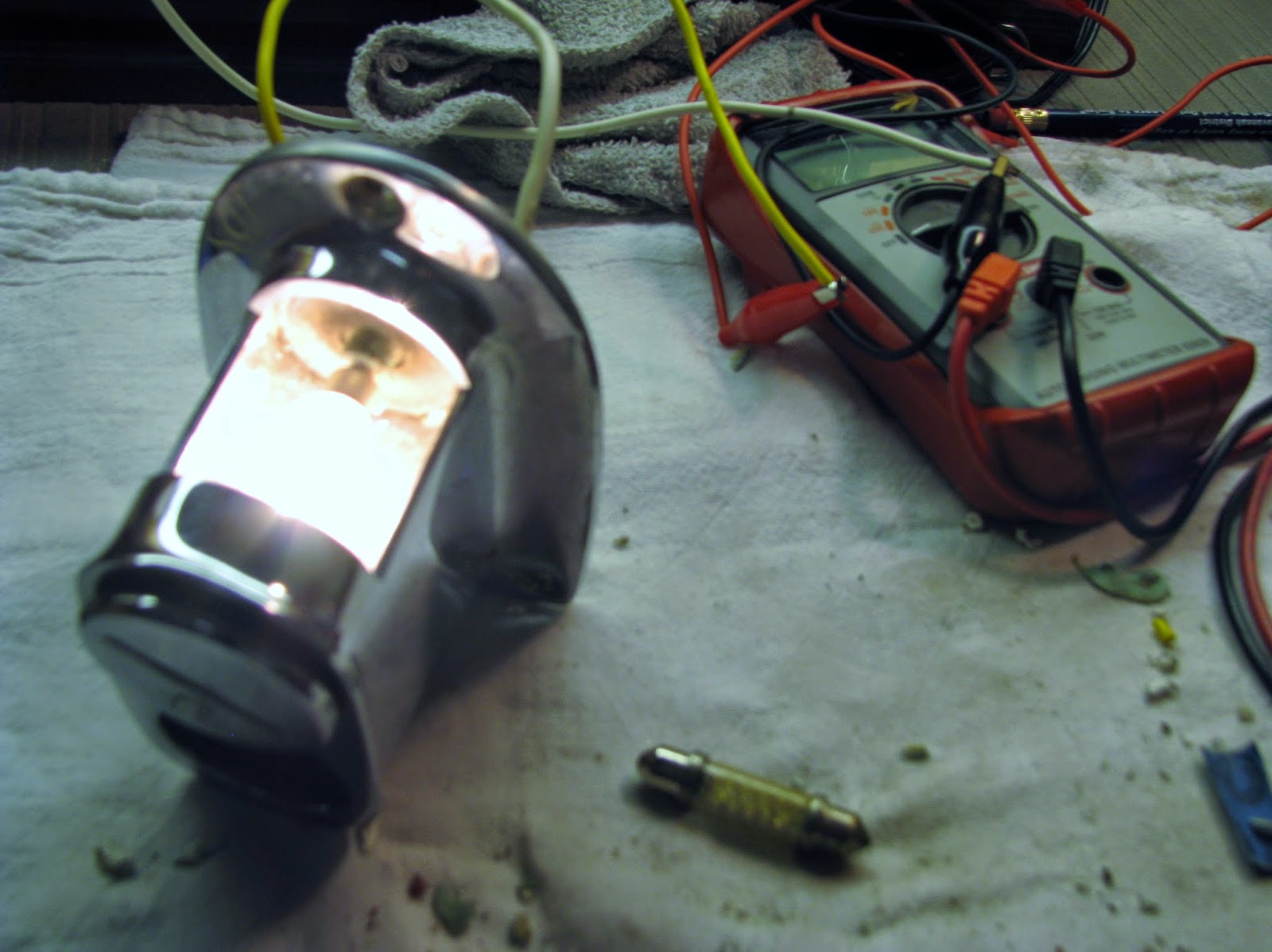
After a few more days, I remove the stern light fitting and take it to the bench in the shop. Application of 12 volts from the bench power supply directly to the LED gets zero result. Hah! Bad LED! Locate, order a new LED.

The next day, with nothing else to do while awaiting the new LED, I put an incandescent bulb in the stern light fitting as an additional test. No light! So, I disassemble the entire light fitting and in the process discover the positive contact is badly corroded. Fix that. Clean the other contact for good measure, reassemble and


...the incandescent light works. (That's the dead LED in the foreground to the right of the light fixture).


So now, I have reinstalled the fixture, reconnected the various splices and reassembled the aft cabin hull liner and floor panels.


Logic tells me that, when the new LED gets here, it will work in this fitting too.


We'll see. I am not too confident. My kind of logic has proven quite circuitous.

Sunday, April 20, 2014

If it's in the logbook...

...it must be true. Oh, well, that's probably right. My brother Paul and I were too busy piloting and going over events of the last 50 years to spend much time fabricating log entries.

So, today it is blustery and rainy in Augusta and I am reading the logbook, re-living the trip and looking for numbers to calculate fuel consumption. Entries are interesting, in a minimalist kind of way. Here's the whole voyage, according to Ms. Bettencourt's log (with events I didn't enter italicized in parentheses):

April 11, 2014

0930 Underway downstream on the Savannah River with Paul.

1100 Arrived at Lock and Dam. (Called lockmaster on cellphone. He forgot his keys and had to go home to get them. Tied up at the courtesy dock to wait. Walked around in nearby swamp. Tracked black mud into the boat).

1220 Cleared lock. (Idiots fishing off lock wall cast lines over our bows and cabin top. Paul climbs on deck with pocket knife and cuts same. The water level is very high and the current as fast as I have experienced on this part of the river. Paul takes helm while the Captain starts lunch).

1240 Paul hits submerged wing dam. (Wham! Eight-knot momentum carries us over the pilings. Potato chips and trail mix join the mud mess underfoot. Captain springs to helm, pulls throttle to idle and shifter to neutral. Machinery and rudder appear to be undamaged. Bilges dry. Captain steers back to the channel, while Paul says something about changing his shorts).

1815 Anchored in 14 feet of water at Little Hell Landing. (Opened engine access port and placed foil-wrapped yeast rolls on top of motor about an hour earlier. Hot buttered rolls went very well with dinner. Trail mix for dessert).

April 12

(Honda 1000 generator starts on first pull. Strong coffee and toasted English muffins with orange marmalade for breakfast. Paul opens a new bag of trail mix).

0850 Underway downstream.

1030 Burton's Ferry and Highway 301 bridges.

1620 Stokes Bluff Landing. (We slow and ease toward the beach to get a closer look. Bathers seem to flee as we approach. They must not recognize us as relatives. Paul shoots many photos as we withdraw).

1900 Anchored in South end of Cutoff #6 on the Georgia side of the River. Depth 20 feet. (Pitch-black dark with fishing boats moving about. Deployed anchor light. Microwaved lasagna for dinner. Found the Oreo cookies. Life is good).

April 13

(Checked engine oil, coolant and alternator belt. Adjusted shaft stuffing box. Added 10 gallons of diesel fuel from on-board jerry cans).

0920 Underway downstream.

1102 Passed under the unopened SCL Railroad bascule bridge at high tide with 3 feet to spare. (Put the VHF antenna down and had Paul on the roof just in case).

1145 Passed under the unopened Highway 25 swing bridge, vertical clearance 8 feet. Proceeding through Port Wentworth and Savannah Harbor to the Wilmington River and Thunderbolt, GA,

1450 Docked in the basin at Thunderbolt Marine. (It is a custom at this marina to deliver hot donuts to transient boaters on departure mornings. The dockmaster asked how many people Ms. Bettencourt had aboard. First, I said "six," then settled on three, thus assuring a 6-pack of Krispy Kremes for breakfast tomorrow).

April 14

0750 Underway for Beaufort, SC, beset by a swarm of biting 'no see-um' gnats. (Insect spray, prudently packed by the Captain, leaves dashboard littered with little black bug bodies. Weather radio announces a gale warning, so Captain elects an inside route through Calibogue and Port Royal sounds).

1445 Beaufort Downtown Marina. Tied up at Fuel Dock awaiting turn of the tide to move into a nearby slip.
(We meet my friend Major and his wife Linda who have graciously hauled Ms. Bettencourt's trailer to Beaufort for a return trip by road).

1615 Memorable stern-first berthing. (Captain miscalculates. A plan to belay a bow line with a strong wind swinging the stern about into the slip was thwarted by contrary current overpowering the wind. Ms. Bettencourt was jammed sideways, threatening to spear a sailboat with her anchor. Major, Paul and two dock hands achieve control.  Captain administers first aid for barnacle scrapes Major receives from piling).

April 15

0930 Underway for Lady's Island boat ramp. (It is raining torrents, but the current is in the right direction for a departure without drama. Major and Linda are at the ramp with the trailer and loading is wet, but otherwise uneventful. With the boat out of the water, we note a few wing dam dings in the hull's antifouling paint -- wing dam dings? -- but no other damage. There was also a snarl of monofilament fishing line around the propeller shaft, which yielded to my pocket knife).

1320 Launched from the North Augusta ramp into the Savannah River.

1355 Secured at Ms. Bettencourt's home dock.

(Trip statistics: Another 250 nautical miles or so under the keel. The fuel burn was 0.52 gallons of diesel per engine running hour, a number somewhat better than Ms. Bettencourt's usual 0.68/hour rate. All the Oreo cookies were gone. About 1.5 pounds of trail mix remained. It was still raining).


Note: For a closer look at our cruising area you may wish to consult NOAA charts 11514 and 11515 for the Savannah River; Chart 11512 for Savannah Harbor and approaches; and Charts 11507 and 11518 for Calibogue and Port Royal sounds and the Beaufort River.

These charts may be found at: http://www.nauticalcharts.noaa.gov/staff/BookletChart.html

Thursday, April 17, 2014

The first cruise of '14

...in photos shot by my brother as we went down the Savannah River from Augusta to Savannah last week, then to Thunderbolt, GA, and Beaufort, SC. (Click a photo for enlarged views).

You don't have to look very hard to find wrecks on the river. Here's the hulk of a once very nicely restored Chris Craft that disappeared from the marina a couple of months ago. Apparently, it didn't survive a trip over the dam.


A houseboat went missing in Augusta about the same time, but this one isn't it. This vessel looks like it has been in the water a much longer time.


And here's the old steel tugboat Tomochichi, abandoned at Augusta in the 60s, raised and restored in the 70s and abandoned again in a sinking condition sometime after that. She's been yard art at a river home a little north of Port Wentworth, GA, long enough to grow through-hull trees.


The Georgia Power nuclear plant near Waynesboro is adding two new reactor units.


Ms. Bettencourt's 3-cylinder Kubota engine, upon which we heated rolls to go with our dinner the first night out. (If you wrap rolls tightly in foil, they will heat to butter melting temperature in a hour or so of running time and they won't taste like diesel fuel).


A memorable sunset in the anchorage at Little Hell Landing.


Piling wing dams. High water levels made many of these structures, built in the 1930s to help scour river channels, into dangerous submerged obstacles.


A double row of pilings extends underwater from these end posts to the nearby riverbank.


Either a darned big dragonfly or a shrink-wrapped helicopter.


Ocean vessel Arthur Maersk brings containers to the Port of Savannah, assisted by two Moran tugs:


Ms. Bettencourt, hanging with the big yachts at Thunderbolt Marine.


"You again!" the dockmaster said when we arrived the next afternoon at the marina in Beaufort, SC.

"Every time you show up here it rains!"

Paul Stokes photos
The front passed through Beaufort the following morning, with rain slowing only briefly while we loaded Ms. Bettencourt on her trailer.

The boat's back at her dock on the River behind our house now. Planning has begun for the next cruise, probably southward from Savannah in the fall.


Friday, April 11, 2014

Into the wilds! (Finally)

We'll be shoving off from Augusta in a few minutes, bound for Beaufort, SC, via the Savannah River and Thunderbolt, GA. The Savannah riverbanks between here and Savannah are largely uninhabited. No People. No convenience stores. No ice. No groceries. No repair parts. Should be fun.

We will be anchoring on the river two nights before transiting the Port of Savannah to the Wilmington River and thence to Thunderbolt Marina for another overnight before jumping off for Beaufort.

There may be cellphone coverage, in which case we will activate the wireless hotspot and post an update later today or tomorrow.


Sunday, April 6, 2014

"Vorsicht mit der Gelben Gefahr."

That statement, or something like it, has been attributed to Germany's Kaiser Wilhelm-I. It was taken to mean at the time that the West should be wary of oriental powers; that European nations should "...beware the yellow peril." Presumably, he was referring to the growing  military power of Imperial Japan.

But we have a different kind of yellow peril here in Augusta, Ga.: Tree pollen. The stuff is everywhere. It has been wafting down like fine snow all week. And, though this is an annual event, no one can predict when the blizzard will end.


There are even pollen trails on the Savannah River. The photo at right shows a procession of  yellow blobs drifting past our gazebo, headed toward Savannah. (Click on the picture for a closer look).


I have rinsed Ms. Bettencourt twice this week. The boat is still yellow as a gourd. Horizontal surfaces inside are also gritty, but accumulations have slowed since I shut down the solar ventilators.

Meanwhile, preparations continue for the Beaufort, SC, cruise which will commence next Friday. A systems check on the boat yesterday revealed a fault in the navigation lights. The problem turned out to be a double-pole, double-throw on-off-on toggle switch that I can't find locally.

West Marine's warehouse in California had one, which is now on its way to Augusta by (expensive) air freight. It is to arrive Wednesday.

Also, it is always a bad sign when you step onto your boat and the automatic bilge pump starts pumping. Such was the case this morning.  A search revealed that water formerly in the fresh water tank was now in the bilge. I found and fixed a plumbing leak in the pressure water system and refilled the tank.

So, the plan now is to hose the pollen off  Ms. Bettencourt one last time after the final loading Friday mid-morning, then head off down the river to make a noontime date with the lockmaster.

I fear we will  find ourselves in a fog of the yellow stuff most of the 200-mile trip to the coast.

On the bright side: We shouldn't run out of water for coffee and the lights might be working.