About Ms Bettencourt

Ms Bettencourt is a Swedish built 25-foot trailerable trawler. Her hull was completed in 1971, No. 1117 of about 2500 built. The boat is named for my wife Dia, whose maiden name is Bettencourt.

This little vessel came to me as a gift in 2004. Before then she had been abandoned about 12 years on the Savannah River near Augusta, GA. I have repaired and refitted the boat extensively, and I have cruised her along the East coast of the US, from Cape Lookout, NC, to the Florida Keys. I dream of taking her to Havana some day.

This blog started in 2011 to chronicle the building of a hard top for the boat to replace leaky canvas. Since then the blog has become an Albin-25 boatkeeping and cruising journal.


Saturday, November 24, 2012

Failing to make friends

It is said that currents and winds should be our friends when maneuvering a boat in close quarters. We live on a flowing river and our dock is in a place with persistent northerly winds. I have learned to cultivate friendships with winds and currents. Particularly when docking. I have become famously successful at this, both with twin and single screw inboard engine boats -- as long as the bows point upstream and upwind.

Docking in close quarters with the stern upstream is another story entirely.


How did this happen?


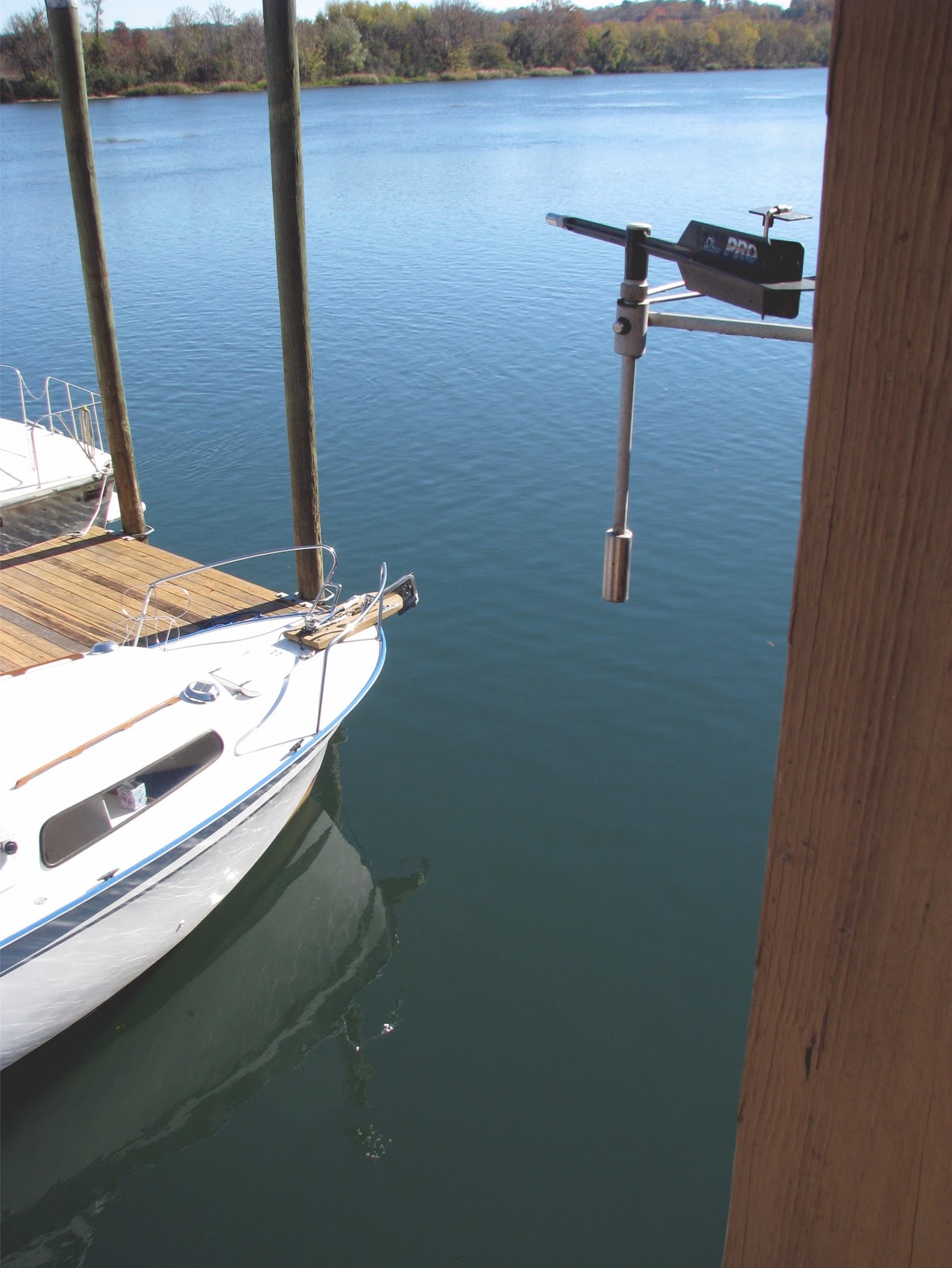
Since we moved the houseboat to the outside of the dock, Ms. Bettencourt has sheltered on the shoreside. Here, she is shown moored with her stern upstream. But, surprisingly, I have not been able to make friends with wind and current in this slip. There is a current eddy in this little pocket of water and the wind is always flukey and often gusty.


It is not uncommon for the weather vane atop the gazebo to be registering a steady northwesterly breeze, as it did this morning....


...while the telltale I have mounted over the water about 15 feet  below the weather vane is indicating northeast to easterly winds. (These photos were taken less than a minute apart).


It is not difficult for me to overcome these variables when entering this slip bow-first. If the surface wind is westerly or if it is stormy, I will use a springline,  idling in forward gear to hold Ms. Bettencourt's starboard side to the dock while I tie up.

But, to date, I have been unsuccessful at backing her into this position. Asymmetric thrust from Ms. Bettencourt's right-hand propeller, a relatively small rudder, cramped maneuvering space, slow speed and intimidating obstacles such as these pilings and rocks...


... comprise a test of nautical courage that I continue to fail badly.

So, to answer the question at the start of this post:

How did this happen?

I have been coming in bow-first, then jumping to the dock and using a long line from the port quarter and a big fender to flip her bow downstream.

This is an effective process, the nautical term for which is "winding ship."

But for me, it is not very satisfying. Doing it this way seems like cheating.  This maneuver can't be done with docking 'elan. Passersby would be unimpressed.

So, I will continue to practice stern-first approaches. I think success will depend on learning how to steer in forward gear, whist making sternway in the desired direction. And, of course, I will have to become very friendly with winds and currents in this constricted area.

Perhaps an effective method will develop sometime soon, in which case I will post a video. Please stay tuned.


Saturday, November 17, 2012

Dealing with @!*#! canvas fasteners

A device known as the "lift the dot" canvas fastener ranks at the very top of my marine hardware enemies list.

It's a post and spring assembly  that is supposed to secure a canvas closure and to release when you lift at a dot stamped on the fastener face. It does the first function admirably. But I can't get mine to let go -- short of prying them apart with a tool.


Ms. Bettencourt's new canvas has a bunch of these things, installed mainly to hold rolled up canvas or clear window panels with vinyl straps.

I am replacing them with Common Sense twist-lock stud  fasteners from Sailrite:
http://tinyurl.com/b79tttr


Here's the hardware, together with an eyelet I found easy to install on one of the side panel roll-up straps: (My pocket knife is in the picture to provide a sense of scale). The pieces are, from the top:


-A twist-lock stud and its backer plate


-An eyelet installed on a vinyl strap

-An eyelet and its backer washer


I think you can see why they named these  Common Sense fasteners. Installing the first eyelet was a simple job, though I probably would have messed up had I not watched the how-to video that Sailrite provides on its website.

Putting the stud part of the fastener on the canvas was even easier, since the the prongs on the stud fit neatly in the slots the canvas guy had cut in the material for the "lift the dot" fastener posts.


And here's a completed assembly on the canvas, the first of many I need to get done while the weather remains sunny and dry.


In other news-- I found the the reason the fuel gauge dropped to beyond empty and refused to move, even though the tank is full to the fill neck. The solution was simple: I Googled "troubleshooting Teleflex gauges" and found a step-by-step process on the Jamestown Distributors website: http://tinyurl.com/coory5g

It turned out that there is nothing wrong with the gauge. The sending unit inside the tank has failed. I have acquired a replacement sending unit, but installation will have to wait until I have used up most of the fuel in  tank. At Ms. Bettencourt's usual consumption rate, that will be about 29 hours of engine running time. The tank might be nearly dry sometime next spring.

And finally, the curtains project remains on hold. This job might have to wait until spring as well. I still can't muster sufficient confidence to start cutting that expensive material.


Saturday, November 10, 2012

500 Boats!

Fifty-three rowing clubs from 38 cities and 13 states are on the Savannah River today for the 16th Annual Head of the South Rowing Regatta. This is a day-long, 76-event big deal in Augusta.


In the photo to the right, a flock (fleet?) of 6s and 8s are heading out from the Augusta Rowing Club Boathouse. The starting line is about 5,000-meters upstream.


Early morning temperatures on the water were in the 40s, but if any rowers found this uncomfortable, they didn't seem to show it.


Some are stripped for action, but the coxswain of this 8 remained bundled up and kept her ears warm.


We were on the race course in Ms. Bettencourt yesterday and the water temperature at the surface was 61F.  The river is now closed to all but regatta traffic from a mile south of the Boathouse to about a mile upstream past the downtown area. There are more than 1,300 competitors on the water, plus event judges, timekeepers, safety people and others.

Today looks like a good day to stay home and figure out why Ms. Bettencourt's fuel gauge has stopped working.


Saturday, November 3, 2012

Moving the Big Guy

There is something very pleasurable about having your hands on the throttles of  big engines; having the ability to summon about 500 horsepower with just a push of the palms. That memory flashed back this week when I fired up the big V-8s on the houseboat "Tybee Island" and shifted her berth to the outside of our dock on the Savannah River.


Houseboat Tybee Island at her new berth


          The levers of power


Actually, I hardly used the throttles. Over the years we have owned this boat, I have become adept at maneuvering in close spaces with the transmissions alone. With the engines idling, I put the rudders amidships, then leave the steering wheel untouched.

In this case, shifting the port engine astern and adding a little port throttle backed us out of the slip just as slick as a snake. Then some back-and-forth shifting, again with engines idling, engaging one transmission, then the other, forward, then astern, then both ahead, brought us alongside the dock face, where Dia was waiting with a bow line. In all, a very satisfying evolution.


Maneuvering with transmissions


This was the first time I had moved the 47-footer since last April. There was a problem with one of the Rochester QuadraJet carburetors, compounded by an extreme case of houseboat disinterest. This resulted in ever-lengthening periods of the boat just sitting there, making us feel bad about not using her.

We have decided to put Tybee Island on the market, and my job is to get the boat ready for an appraisal, a precursor to advertising it for sale.

We are the second owners of this Harbor Master houseboat. She's 25 years old, but still shipshape and frisky. The boat has just about every feature imaginable- fly-bridge with Bimini top, two heads, two staterooms with double beds, three air conditioners, big kitchen, full-sized fridge and so on. She also has those two big Crusader inboard engines, a 4-cylinder 6.5 kilowatt generator and a 200 gallon gas tank, which is about half full at the moment.

Making her ready for sale is a bittersweet task. We have owned the boat about 10 years and have had many happy times with her. But our interests have changed. Disuse is not good for a boat.

Meanwhile,  Ms. Bettencourt has been moved to the comfy inside slip, where she is even more accessible for curtains fittings and for future cruise preparations.


Saturday, October 27, 2012

Sustaining the machinery

Taking care of the engine, transmission, wiring, plumbing, and other machinery on a boat is an important responsibility. Carefree cruising in a power boat begins with confidence in the propulsion package. That said, actually getting to the machinery on an Albin-25 is not an inconsequential evolution. It's not like popping the hood on your passenger car.

Not all Albin-25s are alike, but none has easy access to the engine space. On Ms. Bettencourt, the work begins with taking up the wooden floor panels. Lifting the panel closest to the aft cabin provides relatively easy access to the raw water intake strainer, the primary fuel filter, and the propeller shaft stuffing box. Today, I cleaned some debris out of the raw water strainer, checked the fuel filter for water (found none) and tightened the stuffing box a bit to compensate for worn packing.

Taking out the next floor panel forward allows for inspection of the engine exhaust cooling elbow, coolant circulating hoses and the aft bilge pump.

(Note that the operator's seat, which is normally over the engine box, has been removed from its brackets and stowed across the bench seats against the aft cabin door).

With these two deck panels and the operator's seat out of the way, it is now possible to swing the half-bulkhead leading to the forward cabin forward on its hinges, then unlatch and swing the engine box lid upwards and back toward the rear of the middle cabin. I have done this while underway and it is not fun. Anyway, we can now view the engine and and the sound insulation on the inside of the engine box lid.


This is a Universal 54-24 diesel engine. Only about 1,000 of these Kubota marine conversion 3-cylinder engines were made, between 1977 and 1983. That means this one is between 29 and 35 years old. The engine has about 2,500 hours on it, which makes it relatively youthful. It is not unusual for a well cared for little diesel to go 10-15,000 hours before it needs a major overhaul.

(You can click on these pictures to enlarge them, if you wish to examine anything more closely).

On our last cruise, we ran this engine for about 18 hours at 85% of its power capacity. I think that's equivalent to running a modern passenger car about 1,000 miles at 60 miles and hour.

Today, while I had the lid up, I added about a half-pint of antifreeze, checked all the hose connections for leaks (found none) and tightened the alternator belt. I also checked the oil, then moved to the rear of the engine to check the transmission fluid and propeller shaft flange.


This picture is looking down on the top of the engine from the rear. The transmission is that box shaped gizmo at the bottom of the photo. There is a plug on the top of the transmission which may be unscrewed to check the fluid level. Ms. Bettencourt didn't need any today.

At the very bottom of this photo you can see a flange with bolts through it. This is where the transmission attaches to the propeller shaft. I always check those fasteners to make sure they are tight.


The final deck panel to come up is the one under the helmsman's feet at the steering position. A 20-gallon waste holding tank resides under there, together with a Y-valve that allows waste removal either through a deck pump-out fitting or overboard through the hull by means of a diaphragm hand pump. I keep the Y-valve locked in the deck pump-out position and the through-hull valve closed.

I pulled this panel up today mainly to check hose and pump connections and to retrieve a screwdriver I had dropped behind the tank.

Everything was in order in this department, so it's time to put it back together. I had everything buttoned up in about 10 minutes.

The engine will get a major service shortly before Ms. Bettencourt's (presently unscheduled) next voyage.

That work will involve an oil and oil filter change, changing the primary fuel filter cartridge, testing the batteries, checking all battery connections, and re-checking everything I checked today.


Saturday, October 20, 2012

Do real mariners sew curtains?

The ragged remnants of moldy old curtains hung in her windows when Ms. Bettencourt came to me in 2004. When I pulled them down, the rusty curtain rods and plastic brackets came with them.

In the context of the rest of the long-abandoned boat rehab mess I was facing at the time, new curtains were immediately assigned a "maybe someday" priority.

A long time passed. Then, a couple of years ago, I happened on a source for 1/4-inch fiberglass rods. I bought some rods, made some oak brackets and installed curtain rods at the tops and bottoms of the forward and aft cabin windows. After that, the project stalled. The curtain rods have been used mostly for towel racks. After the last cruise, however, it was decided the time had come for curtain work.

My wife Dia helped me select material. Dia doesn't sew--even buttons--but she has a great eye for colors, patterns and how decorative stuff works together. She is also good with coupons and getting deals at stores. My friend Paul's wife Erena, who is an accomplished interior designer, looked at my windows photos and measured drawings and helped estimate how many yards of fabric we should buy. She told me how to sew headers and rod pockets. She told me there is a difference between hems and seams. She said I should use Mercerized cotton thread.

I'm thinking: Hey, how hard can this be? We're only talking about six little windows. This will not be a Martha Stewart project. Sewing machines are not that complicated. I remember my mother helping me make a shirt for a Teddy bear with her sewing machine. I don't remember if she was sewing the shirt, or if I was at the controls. Nobody was hurt, as I recall.

My friend Major has a sewing machine he said I can use. Nevertheless, I am now thinking this might be more difficult than expected.

Perhaps the next thing I need to do is to cut some fabric. I hate to do that. The stuff looks so good on the roll. Scissors are unforgiving implements. Cuts are forever.

Dia says we should hire somebody to make the curtains. I am going to the library to get some sewing books. This job can wait awhile longer.


Saturday, October 13, 2012

Driving off the edge of the Earth

South Carolina's Waccamaw River is an impressive stream where it joins flows with the Black, Pee Dee and Sampit Rivers to form Winyah Bay at Georgetown. It was a dark and cloudy morning last Tuesday when Ms. Bettencourt transited the Bay and headed upstream. The destination was Conway, SC, a little town located near the navigable end of the Waccamaw.

Like many minor rivers in the South and Southeast US, the Waccamaw served as highway for commerce from colonial times until the coming of the railroads. In the years before the Civil War, the river was lined, first with indigo, then rice plantations. Georgetown was a rich shipping nexus for agricultural riches coming from the interior. Today, there is still evidence of the rice culture along the Waccamaw. The structure in the photo below marks a rice irrigation canal on the western bank of the river a few miles upstream from Georgetown.


Almost all the rice plantations behind these canal gateways have reverted to marshland. Much of this area  is government protected, serving as wildfowl habitat and breeding grounds for ocean creatures, most notably shrimp.


Farther up the river, which still runs wide and holds channel depths from 20 to 30 feet, you'll find a few modern marinas serving housing communities. Houses and condos are often out of sight from the river behind low-lying cypress swamps. Then the river begins to narrow.

Major Sims photo


The tops of many of the larger cypress trees were shorn off by Hurricane Hugo, which swept through the area in 1989.


And the river continues to narrow. Lengthening shadows late in the day give the stream a somewhat ominous aspect.

Major Sims photo


I have been a longtime user of Claiborne Young's Cruising Guide to Coastal South Carolina and Georgia. We had a copy aboard Ms. Bettencourt. The first time I read the following admonition, it didn't really register.

Writing about the Upper Waccamaw, Young says: "Most of the route is uncharted, but it is well-marked and easy to follow if you watch out for various forks along the way."


Then rounding a slight bend, as the river continued to narrow, we learned the meaning of  "uncharted." It means that your chartplotter has no cartography. No soundings. Not even stream boundaries. We had driven off the edge of the Earth.


This screenshot from my Garmin 546s chartplotter shows part of our tracks to and from Conway. Before we made those tracks, there was just plain, empty green screen on the chartplotter. We were hurtling, blindly, at 6 knots through a solid green uncharted never-never land

And the river was getting narrower and loopier. And it was getting later in the day. And we had not seen a sunbeam since the previous week.

My friend Major claimed he was hearing dueling banjos. Then he started humming the theme from Gilligan's Island. "We may never get out of here," he said, clasping an unopened package of Oreo cookies to his chest. "When the food is all gone, these will cost you $8 each."

Of course we had the paper charts for the Atlantic Intracoastal Waterway. However, the Upper Waccamaw is not to be found there. But finally, as the river narrowed even more, we began to see day markers. They were widely spaced, but they were useful guides. Eventually we began to see houses. A little later we found the Conway City Marina and, an hour or so after that, a decent Philly steak sandwich just a few blocks down Elm Street.

An early departure the next morning came with just a little low lying fog and a hint of sunshine. Then the sun popped up, and we got a good look at all the sights that were just looming in the murk on the trip upstream. For example, the coffee color of the river water became evident in the wake.


The Waccamaw is one of several South Carolina rivers known as blackwater streams. The coloration comes from tannins leached from the cypress swamps.


Before long, and after getting lost in upper river loops only twice, we found the Lower Waccamaw. An outgoing tide, plus the river's current, moved Ms. Bettencourt at surprising speeds. At one point we clocked a GPS speed over the ground of  7.9 knots. That's fast for a boat with a calculated hull speed of 6.2 knots and a cruising speed closer to 5.5.

We were back at our space in Georgetown's Harborwalk Marina with plenty of daylight left before supper. Ms. Bettencourt was on her trailer at 9:30 the following morning, and back at her dock in the Savannah River at Augusta before 3 p.m.


Trip statistics

Our explorations out and back totaled about 75 nautical miles. We put 18.4 hours on the engine, which burned 12.5 gallons of diesel fuel. That works out to a burn rate of 0.68 gallons per hour.

The next voyage

 Destinations we talked about driving back included the Dry Tortugas National Park, about 70 miles West of Key West Florida; Sanford, Florida, via Jacksonville and the St. Johns River, and the Gulf  Intracoastal waterway via Stuart, Florida, and the Okeechobee Waterway.

And, of course, we will be closely watching the diplomatic news, looking for any change of rules that might allow a call at the Port of  Havana.